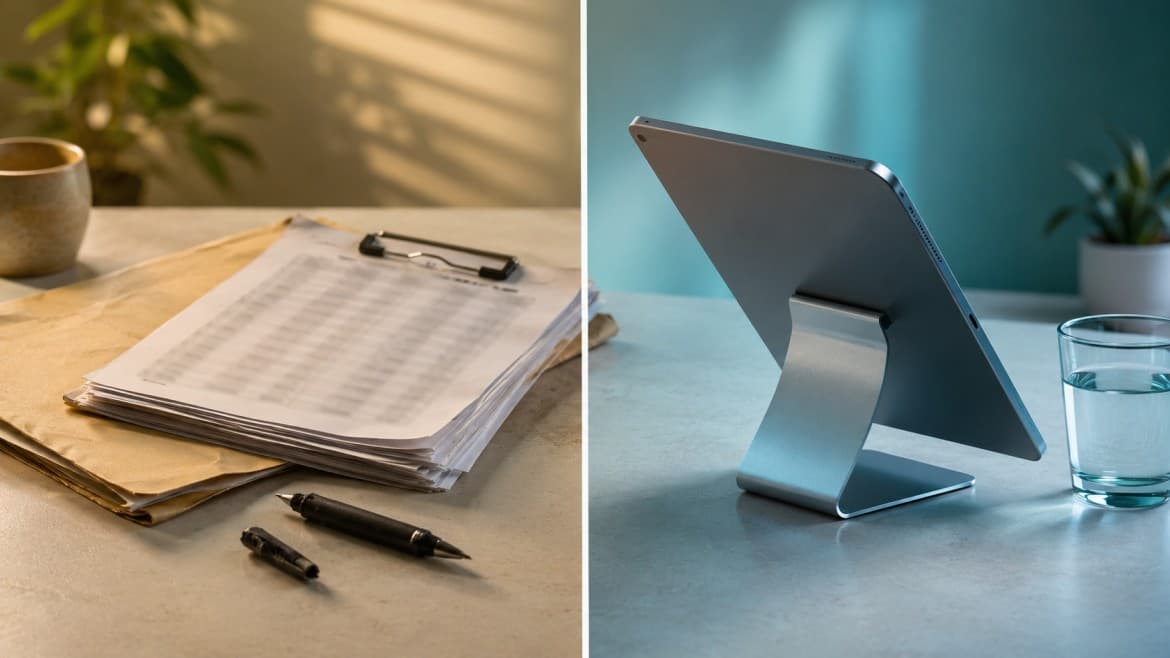
If you run an adult family home, the paper MAR vs eMAR question is not a tech debate. It is a question about how much of your week disappears into a clipboard, and how many quiet citations you are stacking up without knowing it. The state does not require electronic records. WAC 388-76-10430 is about content, not format. The cost difference shows up everywhere else.
Key takeaways
- Paper MAR is legal under WAC 388-76. The state cares about content, not format.
- The hidden cost of paper shows up in time, errors, late corrections, and inspection prep.
- An eMAR built for AFHs runs the dose, the refusal reason, and the PRN narrative in one pass.
- The break-even on a small home is usually one missed citation or one weekend of overtime.
- The right comparison is total cost of ownership, not price per month.
What WAC 388-76 actually requires
The rule is short, and it says nothing about pens or screens. The home must keep a medication system that includes an assessment of help needed, a care plan that names the medication service, a medication log that stays current, and records of all prescribed and over-the-counter meds with the prescriber. Both paper and software satisfy the rule when the work behind them is done well.
WAC 388-76-10430 in plain English
You must have a medication system. The system has to make sure every resident who needs help is assessed, has a care plan covering meds, has a current log, and has a current list of meds with prescribers. The format is up to you. The completeness is not. Plain-language summary, not legal advice.
WAC 388-76-10475 in plain English
Each resident who is not medication-independent needs a daily log. Every line on the log has to include the resident name, every med with dose and frequency, the time the dose was due, and the initials of the person who gave or assisted with the dose. Refusals need a reason. Changes need a date and a note about the call confirming the order. Plain-language summary, not legal advice.
Paper MAR vs eMAR: where the time actually goes
The fastest way to feel the cost difference is to count entries. A 4-bed home with three med passes a day creates about 360 MAR entries in a typical month, plus PRNs, holds, and narratives. Each entry has to be initialed on time, with a clean reason if it is not given as ordered.
| Task | Paper MAR | eMAR (Marpass-style) |
|---|---|---|
| Time per med pass, per resident | 12 to 20 minutes including paperwork | 3 to 5 minutes start to finish |
| Refusal documentation | Circled R, may or may not have a reason written next to it | Required field on the device. Cannot close the pass without it. |
| PRN follow-up | Sticky note or a separate page that gets filed later | Automatic prompt 30 to 60 minutes after the dose |
| Late entries | Different pen color, no clear timestamp, looks like a fix-up | System-stamped late-entry marker with date and time of entry |
| Inspection export | Photocopy six months of binders | One-tap PDF for the month or quarter |
| Pharmacy med-list reconciliation | Manual cross-check between med list and MAR sheets | One screen, both lists visible side by side |
Where paper quietly creates citations
The state does not write you up for using paper. It writes you up for the content gaps that paper makes easier. A blank box on the MAR is treated as a missed dose. A circled R with no reason is a missing refusal note. A PRN with no follow-up score does not meet WAC 388-76-10475. A pile of correction fluid on a single page invites the kind of question you do not want to answer.
The four paper failure modes surveyors flag most
First, blank boxes that read as missed doses. Second, refusals with no narrative under the circled R. Third, PRNs with no effectiveness check 30 to 60 minutes later. Fourth, new orders that show up on the MAR before the medication list on file gets updated to match.
When paper actually wins
To be fair, paper has two real strengths. It does not go down. A tablet that dies at 2:00 am means a caregiver has to fall back to a backup process, and that process needs to exist. A binder of paper MARs cannot crash. The other strength is the absence of a learning curve. A caregiver who knows pen and paper does not need an in-service to start a shift.
Both strengths are real. Both have boundaries. A modern eMAR runs offline on the tablet and syncs when the network returns, which removes most of the downtime risk. And a good eMAR onboarding takes a single shift, not a week. The right way to think about the decision is not "paper versus tablet" but "what is the lightest tool that produces a record I can defend to an inspector without losing sleep."
Two real adult family home scenarios
Nora runs a 5-bed AFH in Lynnwood. She kept paper MARs for three years and was proud of how clean the binder looked. The first week she ran the same pass on a tablet, her caregivers got 35 minutes back per shift. The second month, the tablet caught two duplicate doses that the night shift had been quietly correcting on paper. The duplicate was not a clinical disaster, but it was a quiet pattern that would have been a tag on an inspection.
Diane owns a 6-bed home north of Bellevue. She lost a star on her last inspection because the May MAR had four missing initials and one PRN with no follow-up. The deficiency was correctable. The hassle was not. She moved to an eMAR the next quarter, not for the technology, but because she did not want to spend another hour arguing with an inspector about a missing pen stroke.
Hector runs three homes south of Seattle. He has spent the last year tracking total cost of ownership for both systems on his middle home. Paper looked cheaper on the line item. Total cost, once he added clipboard time, photocopying, late-entry rework, and one missed citation in 2025, came out 31 percent higher than eMAR for the same period.
A simple total cost of ownership example
The price-per-month line item is not the right comparison. Here is the math on a typical 4-bed home, comparing a year of paper to a year of eMAR.
| Cost line | Paper MAR (annual) | eMAR (annual) |
|---|---|---|
| Software subscription | $0 | $1,200 to $1,800 (flat per home) |
| Paper, printer toner, binders | $240 | $40 |
| Caregiver clipboard time (30 hr/mo at $24/hr loaded) | $8,640 | $2,160 (7.5 hr/mo) |
| Admin time on month-end audits (4 hr/mo at $45/hr) | $2,160 | $540 (1 hr/mo) |
| Cost of one survey deficiency cycle (avg time to clear) | $1,500 (assume one per 18 months) | $0 to $500 |
| Total | $12,540 | $4,440 |
The numbers in your home will be different. The shape will not. Once you count clipboard time and the cost of clearing a single deficiency, eMAR pays for itself before the second quarter.
How Marpass is built for adult family homes
Marpass runs the medication pass on a tablet that lives next to the med cart. Every dose is timestamped. Refusals and PRNs ask for a reason in plain language, so the MAR is complete the moment the pass is done. Care plans, dose logs, and inspection exports live in one place. The whole stack is built for adult family homes and small ALFs, not retrofitted from a nursing-home product. Pricing is flat per home and published on the site, so there is no quoting game.
Want to see how a 3-click med pass feels? Join the waitlist.